Warren Bei: The Mathematical Prodigy Redefining Academic Excellence
From West Vancouver to a perfect IMO score and MIT acceptance—Warren Bei is leading a new era in global mathematics

Introduction
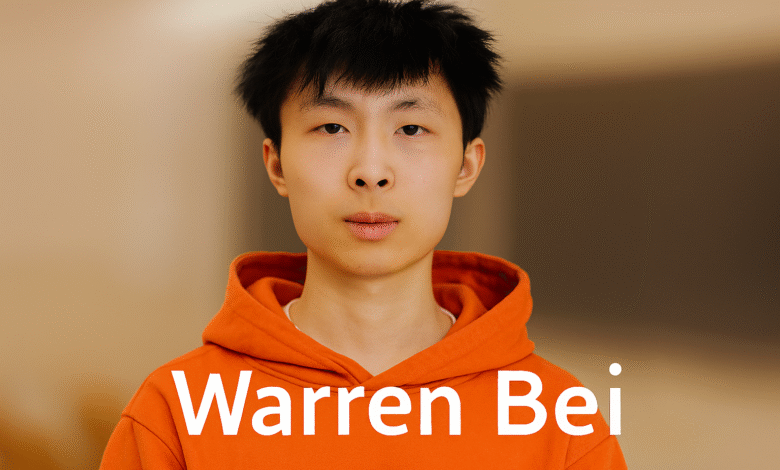
Warren Bei is a Canadian mathematician, competitive programmer, and MIT student known for his outstanding record in national and international academic competitions. He rose to public attention through repeated victories at the Canadian Mathematical Olympiad and medal-winning performances at the International Mathematical Olympiad.
His competition record includes four Canadian Mathematical Olympiad championships, three IMO gold medals, two IMO silver medals, and two silver medals at the International Olympiad in Informatics. His most remarkable result came in 2025, when he solved all six IMO problems correctly and earned a perfect score of 42 out of 42.
Warren’s academic journey connects advanced mathematics with logical reasoning, algorithms, programming, and computer science. His success places him among a growing group of public figures whose work combines mathematics and computer science to solve difficult problems.
Warren Bei is best known as a Canadian Math Olympiad champion who achieved a perfect score at the 2025 International Mathematical Olympiad.
Warren Bei Quick Bio
| Field | Details |
|---|---|
| Full Name | Warren Bei |
| Nationality | Canadian |
| Academic Base | West Vancouver, British Columbia, Canada |
| Former School | Rockridge Secondary School |
| Earlier Education | Homeschooled in Vancouver |
| University | Massachusetts Institute of Technology |
| Profession | Student, competitive mathematician and programmer |
| Famous For | Perfect score at the 2025 International Mathematical Olympiad |
| CMO Record | Four championships and one silver medal |
| IMO Record | Three gold medals and two silver medals |
| IOI Record | Two silver medals |
| Main Interests | Mathematics, computer science, physics, logic and programming |
| Notable Skills | Mathematical proofs, algorithms, coding and creative problem-solving |
| Current Status | MIT student and university-level mathematics competitor |
Who Is Warren Bei?
Warren Bei is a young Canadian academic competitor who became one of the country’s most successful school-level mathematicians. He represented Canada at five consecutive International Mathematical Olympiads between 2021 and 2025.
He earned a medal at every IMO he attended. This achievement shows consistency because the contest presents a completely different set of difficult problems each year. Students cannot rely only on memorised methods or repeated questions.
Warren also represented Canada at the International Olympiad in Informatics. That competition focuses on programming, algorithms, data structures, efficiency, accuracy, and logical implementation.
His ability to succeed in both contests shows a combination of theoretical knowledge and practical computing ability. Mathematical Olympiads require complete written proofs, while informatics competitions require contestants to turn ideas into working computer programs.
Why Is Warren Bei Famous?
Warren Bei is famous for his exceptional results in competitive mathematics. His name became widely recognised in Canada after he repeatedly won the Canadian Mathematical Olympiad and earned medals for the country at the IMO.
His biggest achievement came at the 2025 International Mathematical Olympiad in Australia. Warren received full marks on all six problems and finished with the highest possible score of 42 points.
Only five competitors achieved a perfect score at the 2025 event. The Canadian Mathematical Society reported that Warren became only the sixth Canadian to earn full marks in the country’s history at the competition.
His final school-level IMO record included three gold medals and two silver medals. He also moved near the top of Canada’s all-time IMO Hall of Fame.
Early Life and Interest in Mathematics
Public information about Warren Bei’s early childhood remains limited. However, he has explained that he enjoyed logic puzzles and scientific books when he was young.
His parents noticed his interest and registered him for a mathematics competition. He performed well, and that experience encouraged him to enter more contests.
His development did not begin with a fixed plan to collect international medals. It grew from curiosity, puzzle-solving, reading, and an interest in understanding how difficult problems work.
Logic puzzles helped him recognise patterns and rules. Scientific books introduced him to subjects where careful reasoning and evidence are important. These interests later supported his growth in mathematics, physics, programming, and computer science.
His story shows that strong academic ability can begin with simple activities. A child who enjoys puzzles, numbers, patterns, and scientific questions may gradually develop the skills needed for advanced problem-solving.
Education and Academic Background
Homeschooling in Vancouver
Warren was homeschooled in Vancouver during the early part of his competition journey. He was listed as a homeschooled student from West Vancouver when he represented Canada at the 2021 International Mathematical Olympiad.
He also competed through the Vancouver Learning Network during part of this period. His homeschooling background allowed him to develop advanced mathematical skills while still completing his regular education.
In 2021, he earned a silver medal at the IMO. He also established himself as a leading Canadian mathematics student through strong results in national competitions.
These achievements were especially notable because he was competing against students with more years of formal training and experience.
Rockridge Secondary School
Warren later attended Rockridge Secondary School in West Vancouver, British Columbia. The school became connected with several of the biggest achievements in his academic biography.
While studying at Rockridge, he won repeated Canadian Mathematical Olympiad championships and represented Canada in international mathematics and programming contests.
His education was not limited to standard classroom mathematics. Olympiad preparation required him to study advanced areas such as combinatorics, geometry, algebra, inequalities, and number theory.
His wider interest in programming also gave him experience related to computer engineering, software development, algorithms, and technical problem-solving.
Massachusetts Institute of Technology
After completing secondary school, Warren continued his education at the Massachusetts Institute of Technology. MIT is widely known for advanced study and research in mathematics, science, computing, and engineering.
His move to MIT marked an important change in his academic journey. He was no longer competing only against school students. He entered an environment filled with experienced university mathematicians, programmers, researchers, and Olympiad medal winners.
His competition background prepared him for this change. Years of solving unfamiliar problems had already taught him how to remain patient, test ideas, identify patterns, and write clear mathematical arguments.
Canadian Mathematical Olympiad Journey
The Canadian Mathematical Olympiad is one of Canada’s leading proof-based mathematics competitions. It is designed for highly skilled students who have already performed well in earlier national contests.
The examination does not simply test whether students know formulas. Competitors must explain their reasoning and write complete mathematical proofs.
Warren first won the Canadian Mathematical Olympiad in 2021. He finished second in 2022 before returning to first place in 2023.
He successfully defended the title in 2024 and won the competition for a fourth time in 2025.
His CMO record includes:
| Year | Result |
|---|---|
| 2021 | CMO Champion |
| 2022 | Silver Medal |
| 2023 | CMO Champion |
| 2024 | CMO Champion |
| 2025 | CMO Champion |
In the 2025 competition, Warren achieved the highest score with 27 points out of 35. He also received the Matthew Brennan Award for a particularly short and clear solution to Problem 3.
Winning one CMO championship is a major academic achievement. Finishing first four times shows a much deeper level of consistency.
Every contest presents new questions involving different mathematical subjects. Warren’s repeated success demonstrated that he could adjust his approach instead of depending on one favourite topic or solution method.
International Mathematical Olympiad Achievements
The International Mathematical Olympiad is an annual competition for the strongest secondary-school mathematicians from more than 100 countries.
Each participating country selects a small team through national contests, selection tests, and training programmes. Competitors then solve six proof-based problems across two days.
Warren represented Canada at five consecutive editions of the IMO.
| Year | Medal |
|---|---|
| 2021 | Silver |
| 2022 | Gold |
| 2023 | Gold |
| 2024 | Silver |
| 2025 | Gold with a perfect score |
His complete five-year record can be viewed through the official International Mathematical Olympiad results.
First International Medal
Warren made his first IMO appearance in 2021 while he was homeschooled in West Vancouver. He earned a silver medal during his first year on Math Team Canada.
Winning an international medal during a first appearance is difficult because contestants must adjust to long examinations, strict proof standards, unfamiliar questions, and the pressure of representing their country.
The result showed that Warren was already capable of competing with leading young mathematicians from around the world.
Gold Medals in 2022 and 2023
His performance improved in 2022 when he earned his first IMO gold medal. He returned the following year and won another gold medal in 2023.
His 2023 result placed him close to the top of the international rankings. It also confirmed that his first gold medal was not an isolated success.
Winning consecutive gold medals requires strong knowledge across several branches of mathematics. It also demands discipline, concentration, creativity, and the ability to recover when an early solution attempt fails.
Silver Medal in 2024
Warren received another silver medal at the 2024 IMO in Bath, United Kingdom.
Although the result was lower than his two previous gold-medal performances, it added another major award to his international record.
Competition results often change because every examination has a different level of difficulty. A contestant may perform strongly in one subject but face a problem set that demands a different style of reasoning.
Warren’s return to gold in the following year showed resilience and continued academic development.
Perfect Score at the 2025 IMO
The defining achievement of Warren Bei’s school-level career came at the 2025 IMO on Australia’s Sunshine Coast.
He solved all six problems correctly and received 42 points out of 42. He was one of only five contestants worldwide to finish with a perfect score.
The achievement was important because IMO questions are designed to test original reasoning. They are not routine textbook exercises, and contestants may spend several hours trying to solve a single problem.
His final international record included five medals from five appearances. He earned gold in 2022, 2023, and 2025, along with silver in 2021 and 2024.
International Olympiad in Informatics Success
Warren also demonstrated strong programming ability at the International Olympiad in Informatics.
The IOI tests algorithm design, coding accuracy, computational thinking, data structures, optimisation, and time management. Contestants must write programs that solve difficult tasks within strict technical limits.
Warren earned an IOI silver medal in 2023. He returned in 2025 and earned a second silver medal.
His two-medal record shows that his academic ability extends beyond written mathematical proofs. He can also use logical ideas to design algorithms and create working computer programs.
This combination is valuable because modern research often connects mathematical theory with software and computation. Fields such as cryptography, data science, machine learning, theoretical computer science, and artificial intelligence depend heavily on both mathematics and programming.
Mathematical Interests and Influences
Warren has described mathematics as a source of interesting challenges rather than simply a school subject.
He appears to enjoy discovering the main idea hidden inside a difficult question. This mindset is important in Olympiad mathematics because the hardest part of a problem is often finding the correct starting point.
His interests also include physics, computer science, programming, logic puzzles, and scientific reading. These subjects share a common focus on patterns, rules, structured reasoning, and evidence.
Warren has mentioned recreational mathematician and writer Martin Gardner as an influence. Gardner became famous for presenting mathematical puzzles, games, and logical ideas in ways that encouraged curiosity.
This influence helps explain why Warren’s interest appears broader than competition results. He enjoys the process of exploring ideas, testing possibilities, and understanding why a solution works.
Problem-Solving Style
Warren’s approach to difficult problems involves intuition, experimentation, and trying several methods.
When the first idea fails, he does not treat the problem as impossible. He looks for smaller patterns, tests examples, changes the structure, and searches for a more useful viewpoint.
This flexibility is one of the most important skills in high-level mathematics. Olympiad questions are deliberately written so that common classroom methods may not immediately work.
A successful competitor must remain calm and continue thinking even when progress is slow. Warren’s long competition record suggests that he developed this patience over many years.
His solutions have also been recognised for being short and clear. A correct proof is valuable, but an elegant proof can reveal the central mathematical idea without unnecessary steps.
These abilities may also support future work in research and technology innovation, where difficult problems rarely arrive with complete instructions.
Move From Olympiads to University Mathematics
Entering MIT marked the beginning of a new stage in Warren’s biography.
School-level Olympiads focus on carefully designed problems with known solutions. University mathematics introduces broader theories, advanced courses, open research questions, and collaboration with experienced academics.
Warren’s background gave him a strong foundation for this environment. He had already developed proof-writing ability, computational thinking, self-discipline, and experience working under pressure.
His transition also shows that Olympiad success is not the end of an academic journey. It can become preparation for deeper learning, scientific research, theoretical computer science, or other technical fields.
Putnam Mathematical Competition Achievement
The William Lowell Putnam Mathematical Competition is one of the most difficult undergraduate mathematics contests in North America.
The examination contains twelve problems divided between two three-hour sessions. Even talented university students may complete only a small part of the paper.
Warren participated in the 2025 competition as an MIT student. The university listed him among its high-ranking individual performers when the results were published.
The MIT Putnam competition results placed him in a leading group of students below the highest individual award categories.
This result was significant because it showed that Warren continued to perform strongly after leaving school-level Olympiads.
He successfully moved from competitions designed for secondary-school students to an examination taken by advanced university mathematics students.
Warren Bei Career and Achievement Timeline
| Year | Achievement |
|---|---|
| 2021 | Won the Canadian Mathematical Olympiad |
| 2021 | Earned his first IMO silver medal |
| 2022 | Finished second in the Canadian Mathematical Olympiad |
| 2022 | Won his first IMO gold medal |
| 2023 | Won his second CMO championship |
| 2023 | Earned his second consecutive IMO gold medal |
| 2023 | Received an IOI silver medal |
| 2024 | Won his third CMO championship |
| 2024 | Earned an IMO silver medal |
| 2025 | Became a four-time CMO champion |
| 2025 | Achieved a perfect 42/42 score at the IMO |
| 2025 | Won his third IMO gold medal |
| 2025 | Earned his second IOI silver medal |
| 2025 | Began the university stage of his academic journey at MIT |
| 2026 | Recognised among MIT’s leading performers in the 2025 Putnam Competition |
Skills and Academic Strengths
Warren’s results reflect several different academic skills.
His strongest abilities include mathematical reasoning, proof writing, pattern recognition, algorithm design, programming, time management, and logical analysis.
He can work with abstract ideas while also turning logical methods into practical computer code. This balance helps explain his success in both the IMO and IOI.
His competition record also shows mental discipline. International contests require students to concentrate for several hours while facing problems they may initially have no idea how to solve.
Another important skill is communication. A mathematical proof must not only be correct; it must also explain each step clearly enough for judges to follow.
Clear reasoning is also important in teaching, research, programming, and science communication, where complex ideas must be presented in an understandable form.
Public Image and Influence
Warren Bei’s public profile is based mainly on academic achievement rather than celebrity culture or social-media attention.
He is known as a disciplined, curious, creative, and highly capable problem solver. His interviews also present him as someone who enjoys mathematics and values the discovery process.
His achievements have helped raise the visibility of Canadian students in international mathematics. A perfect IMO score also gave younger competitors a clear example of what focused preparation can achieve.
Warren’s story may encourage students to view mathematics differently. Instead of seeing it only as classroom calculations, they can understand it as a creative subject involving patterns, puzzles, arguments, and new ideas.
His success in both mathematics and programming also shows that students do not always need to choose one technical subject. Knowledge from one area can strengthen performance in another.
Current Status
As of June 2026, Warren Bei is studying at the Massachusetts Institute of Technology.
His school-level IMO career ended with a perfect score, three gold medals, and two silver medals. He has now entered university-level mathematics and computing.
His Putnam performance suggests that he continues to compete at a high academic level. However, his long-term professional direction has not been publicly fixed.
His interests could support future study in pure mathematics, applied mathematics, theoretical computer science, algorithms, physics, cryptography, or another related discipline.
It is more accurate to describe these areas as possible paths rather than confirmed career plans.
Interesting Facts About Warren Bei
- He represented Canada at five consecutive International Mathematical Olympiads.
- He earned a medal in every IMO appearance.
- His IMO record includes three gold medals and two silver medals.
- He received full marks on all six problems at the 2025 IMO.
- He was one of five perfect scorers at the 2025 competition.
- He became only the sixth Canadian to achieve a perfect IMO score.
- He won the Canadian Mathematical Olympiad four times.
- He finished second in the only CMO between 2021 and 2025 that he did not win.
- He earned two International Olympiad in Informatics silver medals.
- He was homeschooled during the early part of his academic journey.
- He later attended Rockridge Secondary School in West Vancouver.
- His early interests included logic puzzles and scientific books.
- He is interested in mathematics, physics, programming, and computer science.
- He continued competing in mathematics after entering MIT.
- His solutions have been praised for being short, clean, and creative.
Conclusion
Warren Bei’s biography presents one of the strongest recent academic competition records achieved by a Canadian student.
He progressed from logic puzzles and early mathematics contests to national championships, international medals, competitive programming success, and a perfect IMO score.
His four CMO titles show long-term dominance within Canadian mathematics. His five IMO medals demonstrate consistency against the strongest young mathematicians in the world.
Two IOI silver medals also prove that his abilities are not limited to theoretical proof. He can apply logical thinking to algorithms and computer programming.
His move to MIT opened the next stage of his academic journey. A strong Putnam result showed that his problem-solving ability continued at university level.
Warren’s future career path remains open, but his record already demonstrates the power of curiosity, patient thinking, creativity, and disciplined learning.
Frequently Asked Questions
Who is Warren Bei?
He is a Canadian mathematician, competitive programmer, and MIT student known for his national and international Olympiad achievements.
Why is Warren Bei famous?
He is famous for earning a perfect score of 42 out of 42 at the 2025 International Mathematical Olympiad.
Where did Warren Bei study?
He was homeschooled in Vancouver, later attended Rockridge Secondary School, and now studies at MIT.
How many IMO medals did Warren Bei win?
He won five IMO medals, including three gold medals and two silver medals.
How many times did Warren Bei win the CMO?
He won the Canadian Mathematical Olympiad four times, in 2021, 2023, 2024, and 2025.
Did Warren Bei compete in programming contests?
Yes, he represented Canada at the International Olympiad in Informatics and earned two silver medals.
What subjects interest Warren Bei?
He has publicly discussed interests in mathematics, computer science, physics, programming, logic puzzles, and scientific books.
What is Warren Bei doing now?
As of June 2026, he is an MIT student who has also achieved a high-ranking result in the Putnam Mathematical Competition.